An architect’s guide to the island’s longest north-coast beach, the working Thai community behind it, and the hillside above.
Maenam translates as “Mother Water” in Thai, the name given to the area because of the streams that run down from the inland hills and feed the wide sandy bay. The local population has lived here on much the same terms for several generations: a working morning market that opens before sunrise, a Thursday walking street that has stayed local rather than turning into a tourist event, the only proper Chinese temple cluster on the island, and a five-kilometre beach that is generally agreed to be the longest north-coast beach on Samui. The Belmond Napasai resort anchors the eastern end. The Santiburi Golf Club, the only golf course on the island, anchors the inland.
For an architect’s client, Maenam is the area that most reliably delivers a settled, working version of Samui without the price tag of Bophut or the development pressure of Choeng Mon. Land is more affordable. The community is real. The hillside has been quietly assembling a serious villa cluster for over a decade. And as Bophut prices have pushed up over the past few years, Maenam has increasingly become the “ten minutes west” alternative for buyers who want similar quality at a more sensible entry point.
An important update for Maenam landowners
A province-wide environmental protection law came into force on 21 May 2025, adding new hillside-development restrictions across Koh Samui, Koh Phangan and Koh Tao — see our island overview for the full rules. Most of the flat coastal strip and the lower band of the Maenam hillside (broadly the established Maenam Hills cluster) sit below the 80-metre threshold and are unaffected by the strictest new rules. Plots higher up the slope, particularly those reaching for the best 180-degree views back across to Koh Phangan, sit inside the new framework and need careful zoning verification.
The land, in three working zones
Maenam splits naturally into three zones for development.
The flat coastal strip runs along the five kilometres of beach, holding the older Thai village fabric, the morning market, the walking street, the small resorts, and the increasing number of new boutique villa developments set back from the sand. This is where The Crest, the boutique beachfront villa clusters, and several of the more recent low-density estate projects (Pacific Noma in Maenam Soi 1, Samran Gardens) are concentrated. Plots are smaller than further inland but the proximity to the beach and the working village commands a premium.
The Soi grid running inland from the Ring Road is organised by numbered alleys (Maenam Soi 1, Soi 4, Soi 7 and so on), and these provide the practical addressing system that buyers and architects actually use. Soi 1 sits at the eastern end nearest Bophut and tends to attract the slightly more upmarket recent development. Soi 4 and Soi 7 inland hold a mix of older Thai houses, modest pool villas, and newer boutique clusters. Most of the new construction in Maenam in 2026 is in this middle band: three-bedroom and four-bedroom pool villas at price points that compete favourably with Bophut.
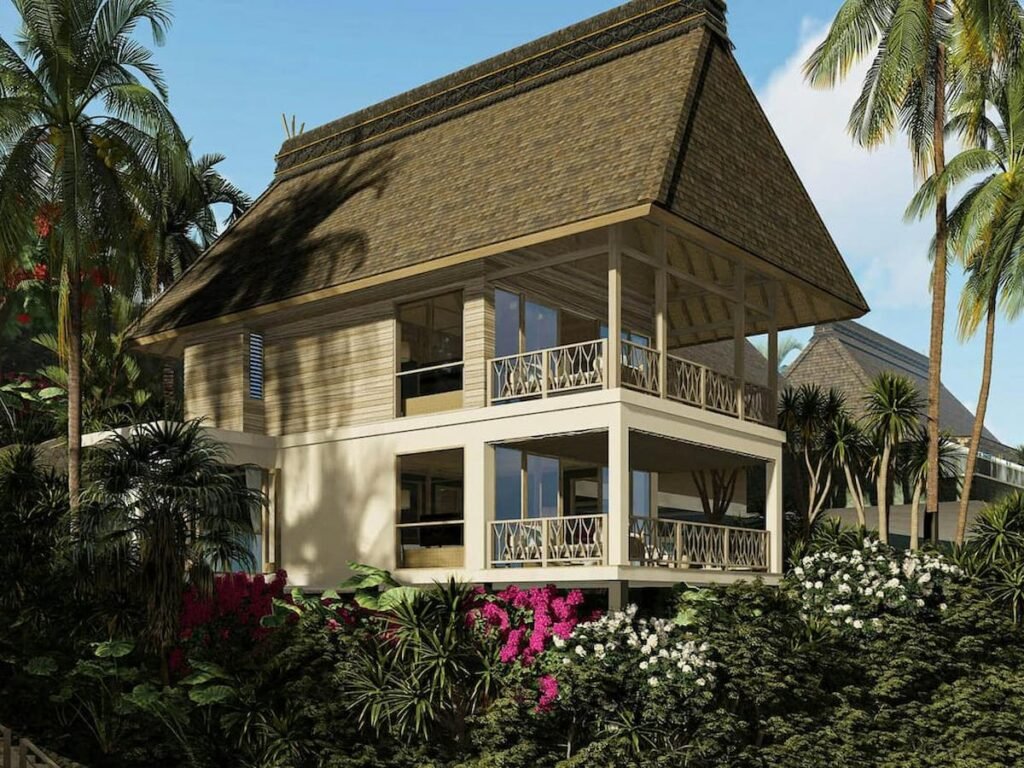
The Maenam Hills above the bay is the third zone. This area has been building up its luxury hillside cluster since the early 2010s, and several of the longer-running villa rental brands (Maenam Hills, Villa Floramare, the cluster around Maenam Soi 7 and beyond) operate from here. The recent Samui Sunset Valley development (Maenam Soi 1) signals where the next wave of hillside product is going: low density, larger plots, contemporary tropical architecture, valley and mountain sunset views, with prices around 22 to 25 million baht. The May 2025 environmental rules apply to anything elevated.
What good Maenam design responds to
Maenam’s beach faces north, which means the design conversation is similar to Bophut’s. Sunrise comes up over the Gulf to the east, sunset falls to the west, and the dominant view direction across to Koh Phangan stays in front of the building all day. North-facing terraces and pools work well in this orientation, with the sun moving around them rather than directly into them.
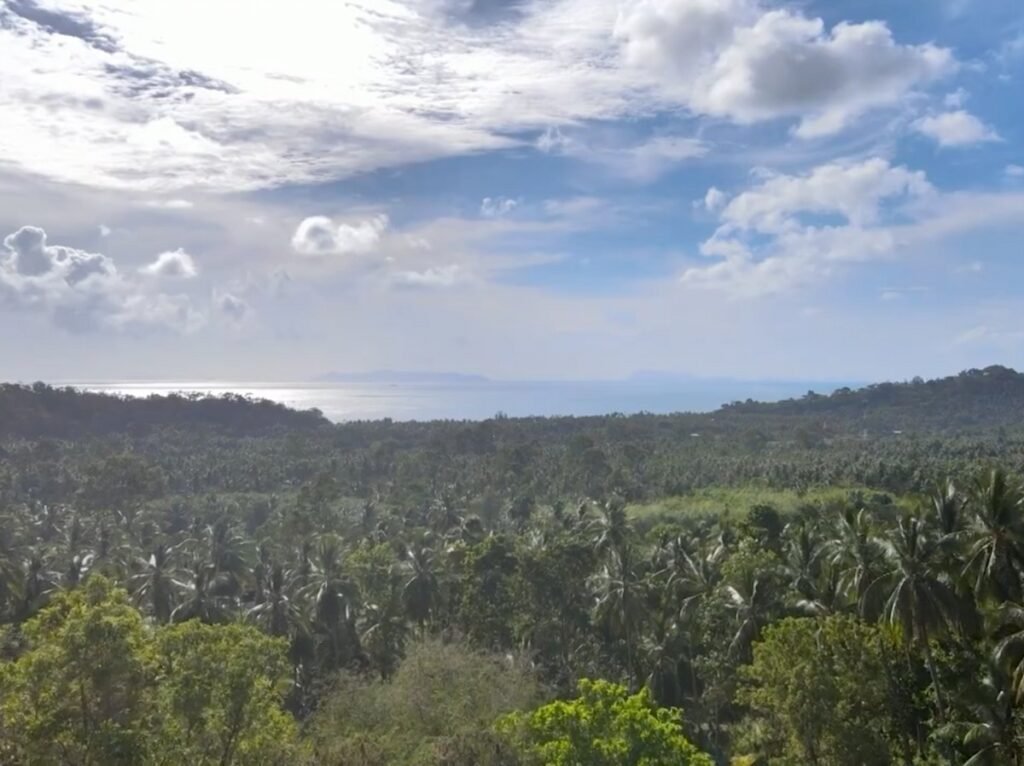
The hillside above shifts the conversation slightly. Most of the elevated plots face north or northwest, capturing both the bay view and the broader sweep across to Koh Phangan. The afternoon sun on west-facing rooms still needs proper shading, but the prevailing view direction usually sits north and the design can prioritise it without compromising too much on solar performance. The best Maenam Hills villas use the slope thoughtfully, with stepped terraces that follow the contour rather than fighting it, and with the building broken into pieces that read comfortably against the hillside.
The northeast monsoon hits the coast from November through January. Drainage on the flat coastal strip needs to handle real storm volumes, and the streams that gave Maenam its name still flow through several of the inland Soi during peak rainfall. Plots that sit on or near these natural watercourses need careful surface water management, and architects working in the area know to check stream and drainage paths during the dry season before any feasibility design begins. Plots on the lower hillside drain better but face runoff scour at the slope-to-flat transition.
Geology is consistent with the rest of the north coast. The flat coastal strip sits on alluvial soils with limited bearing capacity at shallow depth, with pile foundations standard for two-storey work. The Maenam Hills transition to weathered granite with bedrock close to the surface, with the standard 2-metre cut-and-fill maximum applying on slopes above 35 degrees.
Acoustic specification is generally less demanding than in Bophut and considerably less than Chaweng. Maenam’s evenings stay quiet. The walking street operates on Thursdays only and closes by mid-evening. Standard double glazing and decent wall construction is sufficient on most plots, though the Ring Road traffic on the area’s southern boundary is worth checking on plots near the main road.
The settled community as a design context
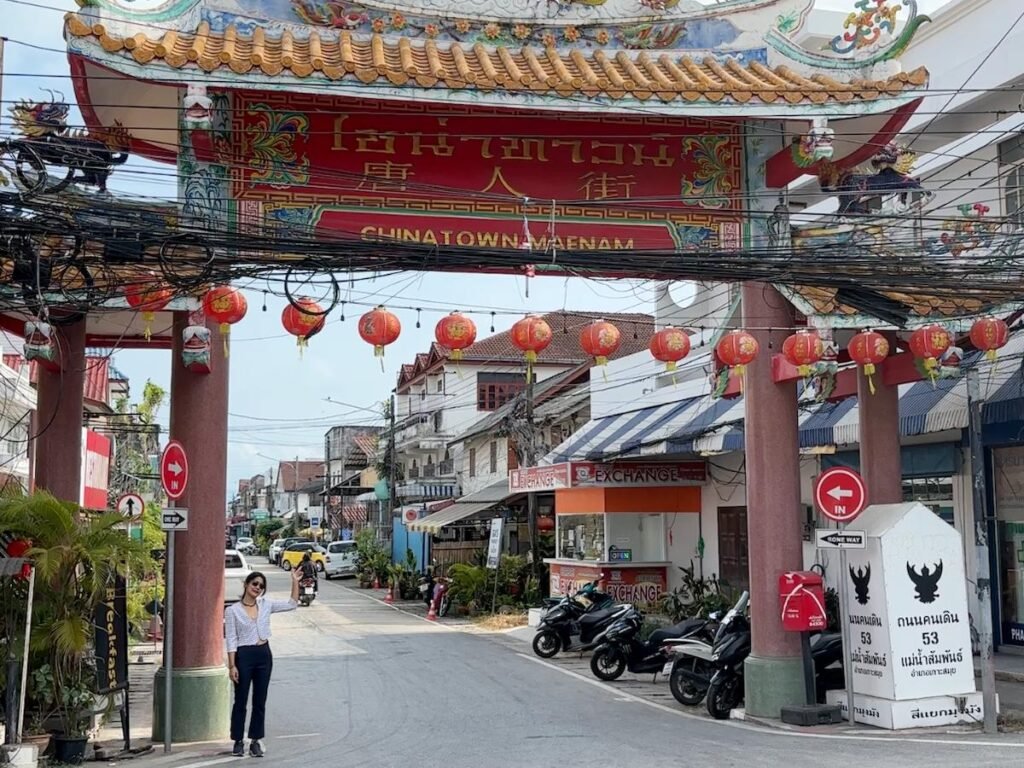
Maenam is the area on the island where the relationship between Thai residents and incoming buyers feels most settled. Long-stay expat residents have integrated into village life over decades. The walking street is a working market where local families shop, not a curated tourist event. The morning market opens at five, runs until ten, and is where most of the area’s better restaurants source their produce. The Chinese temple cluster, including the larger Maenam Chinese Temple, anchors the cultural calendar.
For a building designed in this context, the design discipline is to fit rather than to shout. Tall walls and aggressive boundary treatments read poorly here. Better Maenam architecture sits within the village fabric, uses local materials thoughtfully, and avoids the imposed Mediterranean or Bali styles that have started appearing in some of the more aggressive recent developments. Properly designed contemporary tropical architecture (timber, polished concrete, generous overhanging roofs, real tropical landscaping) works better than the cookie-cutter villa types that some developers default to.
The friction points are practical rather than cultural. The Ring Road traffic gets busy at peak hours, particularly the section between Maenam village and the Bophut T-junction. Some inland Soi have rough surfaces and benefit from a four-wheel-drive in the wet season. The semi-wild dogs that move through the inland village areas are an honest issue, not catastrophic but worth knowing about for clients who plan to walk after dark.
Lifestyle, infrastructure, and access
Maenam’s infrastructure is good for a working residential area. Mains water, three-phase electricity, fibre internet on the main streets and most established residential areas, proper sewerage in the village core. Several supermarkets serve daily needs (Tesco, 7-Eleven, the morning market) but no large hypermarket; for a full grocery shop most residents drive ten minutes east to the Big C or Lotus’s at Bophut. The immigration office is here, which is a genuine practical advantage for expats who would otherwise be travelling to Nathon. Banking, pharmacies, and basic services are readily available in the village.
The road network is decent. The Ring Road runs along the southern edge of the area and connects efficiently east into Bophut (10 minutes), Bangrak (15 minutes) and Chaweng (20 to 25 minutes), and west into Bang Por (5 minutes) and Nathon (15 minutes). The airport is around 20 minutes by road, which is workable for short-stay rental investments. Maenam Pier offers ferries to Koh Phangan and Koh Tao, providing a secondary option to the Bangrak ferry pier.
The community profile is mixed: a settled Thai population, a long-established expat layer, a growing number of younger international residents who have been priced out of Bophut, families with children at the international schools nearby, and a small but visible workforce associated with Santiburi Golf Club and the resorts. The vibe is upmarket but unpretentious, settled rather than transient. Friction with neighbours is rare; the neighbourhoods that work best tend to be the older, more integrated ones rather than the new gated estates that occasionally cluster towards the beach.
For families with school-age children, Maenam is one of the better choices on the island, with the international schools cluster within easy commute. For a long-term resident or second-home owner, the balance of community quality, access, and affordability is hard to match. For an investor focused on short-stay rental yield, the maths sit slightly behind Bophut and Chaweng but are competitive once the lower entry price is factored in.
A practical sequence for a Maenam plot
The standard sequence applies. Confirm the Chanote, check boundaries against the ground, verify zoning under both the older planning maps and the May 2025 environmental zones, check altitude and slope on any hillside plot, confirm distance from the high-tide line for anything coastal, then commission soil and drainage assessments before feasibility design begins.
The Maenam-specific things to watch for are stream and drainage paths on inland plots (not always obvious in the dry season but critical in the wet), access road quality on the further inland Soi (some are still partially unsealed), and the May 2025 environmental layer for any elevated land. Plots near the Ring Road benefit from a peak-hour visit before any commitment, and any plot directly fronting the village walking street area needs careful access planning around Thursday evenings.
Final note
Maenam is the part of the island that does the most with the least fanfare. The beach is genuinely good. The community is genuinely settled. The hillside has quietly assembled some of the most pleasant residential architecture on the island over the past fifteen years, without the headlines that follow Choeng Mon or Plai Laem. Land prices remain sensible, infrastructure is workable, and the recent wave of low-density villa development signals a market that is finally getting the architectural attention the area has deserved for some time.
For a primary residence, a long-stay second home, or a sensible investment in an undersupplied premium market, Maenam is one of the better choices on Samui in 2026. The Mother Water that gave the area its name still runs down through the village, the morning market still opens before dawn, and the slow rhythms that have defined this part of the island for generations are still very much in place.
Considering land in Maenam, Bophut, Chaweng, Choeng Mon, Bangrak, Lamai, Taling Ngam, Lipa Noi, Nathon, or Bang Por? Get in touch for a preliminary land viability assessment. Check out our Youtube channel and the knowledge hub that is full of useful information.
See also:
- Bophut: building in Samui’s original village
- Bang Por: building on Samui’s quiet northwest
- Choeng Mon: building on Samui’s quieter luxury corner
- Bangrak: building under the flight path
- Nathon: building in Koh Samui’s old capital
Note on regulations: zoning, height, altitude, slope, and environmental protection rules are subject to change and to local enforcement variations. The 21 May 2025 Surat Thani environmental law in particular has introduced new restrictions that may not yet be reflected in older online guides. Always verify current rules with the Land Office and a licensed Samui architect or legal advisor before relying on this guide for any acquisition or build decision.