An architect’s guide to land viability, zoning, and what the southwest coast asks of a design.
Lipa Noi sits on the southwest coast of Koh Samui, about 5 km south of Nathon. It is a quiet rural area of coconut plantations, low hills, and one of the few west-coast beaches on the island that is genuinely good for swimming. The local population is just over five thousand. There is no nightlife, no shopping centre, and only a handful of restaurants. For an architect’s client looking for tranquillity, sunset orientation, and land that is generally less expensive than the east coast, Lipa Noi is one of the most considered places to build on Samui.
This guide is written from an architect’s perspective. It assumes you are at the stage of asking whether Lipa Noi is right for your project, what a feasible building on land here might look like, and which constraints will shape the design.
An important update for Lipa Noi landowners
A new environmental protection law for Surat Thani Province came into force on 21 May 2025, applying to Koh Samui, Koh Phangan, Koh Tao, and surrounding islands. It introduces seven new environmental protection zones with significant new restrictions on hillside development.
The points worth knowing for Lipa Noi specifically:
- In the new hillside zones, only one single-family home is permitted per parcel, capped at 6 metres in height with 50% required green space
- Retaining walls and resort-style developments are no longer permitted in the affected hillside zones
- Land subdivision is prohibited in those zones
- On any sloped land at 35% gradient or above, special permission is required to grade or alter the terrain or remove large trees
Most of the flat coastal strip and the lower hills behind it sit below the 80-metre threshold and are unaffected by the strictest new rules. Plots higher up on the hills, particularly those reaching for the panoramic positions above 80 metres, sit inside the new framework and need careful zoning verification before purchase.
The land, what’s actually there
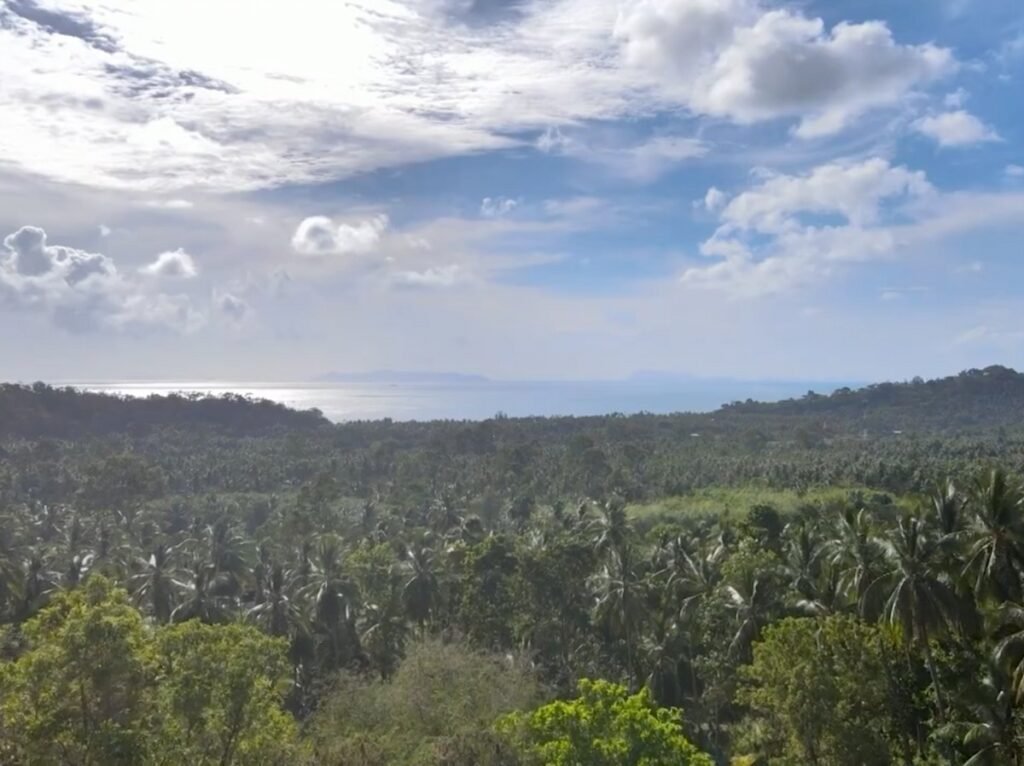
Lipa Noi has a more generous topography than Nathon to the north. The flat coastal strip is wider, often three or four hundred metres deep before it begins to rise. Behind that strip, the land lifts gently at first, then more steeply, into a series of low hills that hold waterfalls and small streams. Coconut plantations still dominate the landscape on both the flat and the lower hills, which is unusual on Samui in 2026 and gives Lipa Noi much of its character.
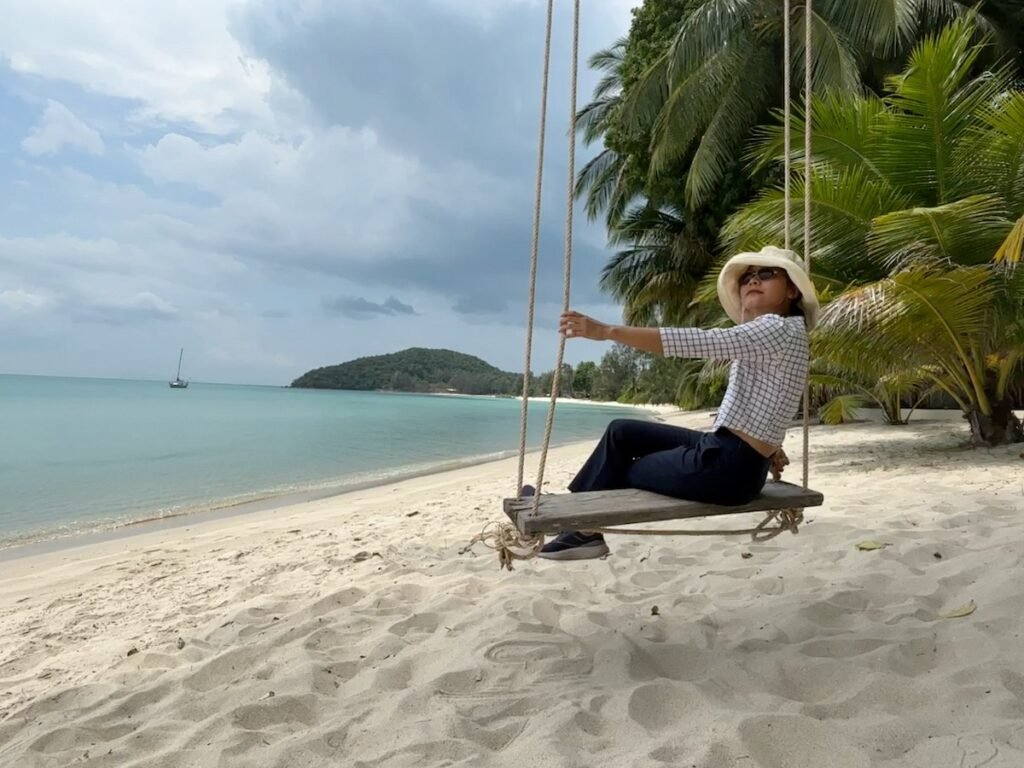
The beach is the clearest single advantage Lipa Noi has over the rest of the west coast. It runs for roughly two kilometres of fine, soft sand. There is no coral, no rock shelf, no sudden drop. The water is shallow for a long way out, calm for most of the year, and warm. It is one of the few beaches on Samui where you can walk straight from the sand into water you can swim in, all year round. For a residential client who wants a beachfront site they can actually use, this is rare.
The Tong Yang peninsula at the southern end of the area is a separate sub-zone. The Raja Ferry Pier, which runs the vehicle ferry to Donsak on the mainland, is at the southern tip. The beach in Tong Yang has an offshore reef in places, which limits swimming at certain times of year but creates excellent conditions for snorkelling. The land here tends to be held in larger plots, with several of the more expensive Lipa Noi villas occupying beachfront positions of half a rai or more.
Zoning, what the planning map actually permits
Lipa Noi spans most of the standard Samui zoning categories, with the mix shifting as you move inland.
Yellow zones (low-density residential) dominate the flat coastal strip and the lower slopes behind it. These zones permit residences and tourism uses, with a 40% open-space requirement, a 12-metre maximum building height, and a 2,000-square-metre cap on total building area for non-hotel projects. For a private villa in Lipa Noi, this is the zoning you are most likely working with, and it is permissive enough to accommodate most reasonable briefs.
Orange zones (medium-density residential) appear in pockets near the local market and along the main approach roads. The use mix is similar to yellow but the open-space requirement drops to 20%, allowing tighter plot coverage. These zones suit small mixed-use buildings or denser residential clusters.
Dark green zones (agricultural and conservation) cover much of the higher ground behind the coastal strip. Permitted residential development is limited, the open-space requirement rises to 60%, and most plots in these zones are not suitable for substantial villa construction. Coconut plantation owners sometimes hold land in these zones and may offer it for sale, but the buildable area is constrained.
Light green and blue zones apply to the coastal and aquatic strips. The standard Building Control Act distance-from-beach rules apply: no construction within 10 metres of the high-tide line; only single-storey structures up to 6 metres in height and 75 square metres in footprint between 10 and 50 metres; up to 12 metres in height with a 2,000-square-metre maximum building area between 50 and 200 metres.
The practical consequence in Lipa Noi is that the beachfront strip is tightly controlled, the coastal strip behind it is well suited to villa development, and the hillside behind that quickly enters protected territory. Most of the better-sited Lipa Noi villas sit in the 50 to 200 metre band from the beach, on yellow-zoned land, with the beach within walking distance but the building itself outside the most restrictive coastal envelope.
Hillside and altitude, the rule that catches people out
As elsewhere on Samui, additional restrictions apply once land rises above 80 metres or steepens beyond 35 degrees of slope. Below 80 metres above sea level, standard zoning rules apply with no extra restriction for single homes. Between 80 and 140 metres, only single residences are permitted, with a 6-metre height limit including the roof, a 400-square-metre minimum plot size, and 50% required green open space. Above 140 metres, the building footprint is capped at 90 square metres.
Slope rules layer on top. Slopes below 35 degrees follow standard zoning. Slopes between 35 and 50 degrees permit only single homes with footprints capped at 80 square metres and 75% of the plot kept as green space, of which at least 50% must be planted with native trees. Slopes above 50 degrees are no-build zones, and recent enforcement under the Samui Model programme has resulted in demolition orders for non-compliant villas in this category.
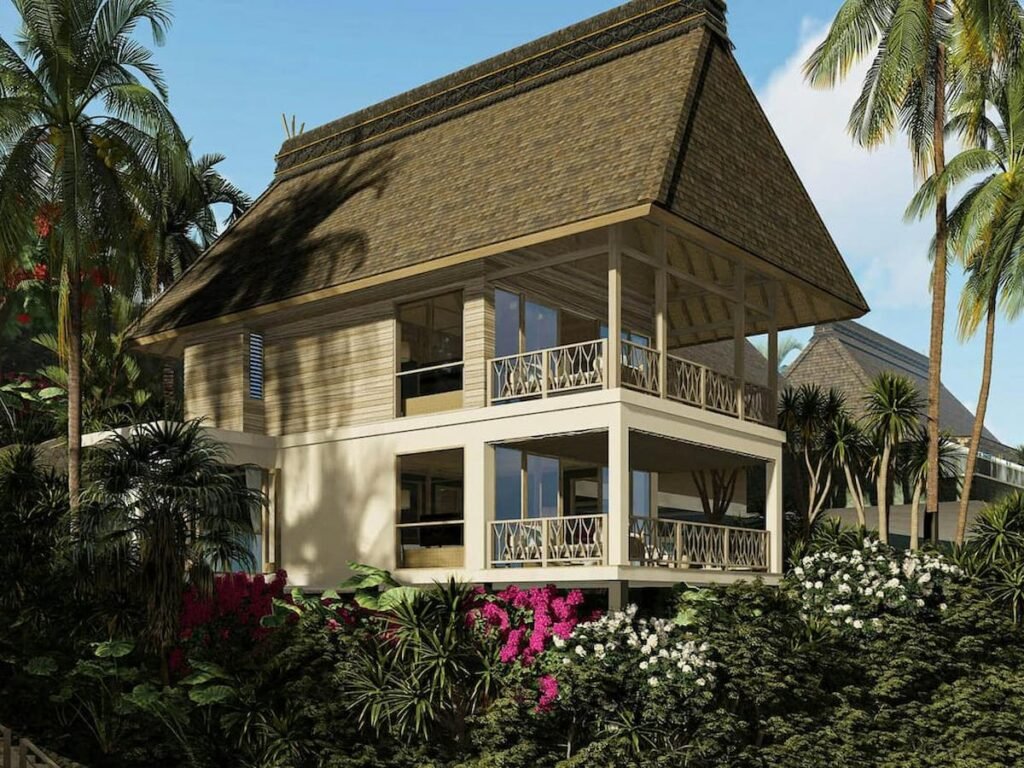
In Lipa Noi the practical impact is that the lower hills behind the coastal strip can offer excellent elevated sites with sea views, but the buildable envelope shrinks fast as you go up. A villa client hoping for a panoramic position above 80 metres needs to accept the 6-metre height limit, single-storey or split-level format, and the loss of two-storey design options. This often pushes the brief towards stepped-terrace designs that follow the contour of the hill, with each level limited to 6 metres and the overall mass kept low.
The Forest Department oversight on hillside land is active, and any plot that approaches protected status should be checked carefully against the latest planning maps before commitment. Reputable architects in Samui will confirm altitude, slope, and zoning before beginning design work, not after.
What a good Lipa Noi design responds to
Lipa Noi shares the west-coast orientation that defines design on this side of the island. The afternoon sun is intense, the sunset is exceptional, and the south-west monsoon hits the coast directly from May through October.
The orientation question is the same as Nathon’s but with a different opportunity. Lipa Noi’s flat coastal strip means many plots have unrestricted west-facing aspect, with the beach and the sunset directly in front. The temptation is to point everything at the view. The design discipline is to frame the view rather than surrender to it. Deep overhangs, recessed openings, screened verandahs, and operable shading systems are standard tools. Glazing is typically specified as low-emissivity to reduce solar heat gain. Roof forms are pitched, both for compliance with Samui’s prohibition on flat roofs and for the practical effect of throwing shade on the western façade.
A design that handles the west aspect well will treat the late afternoon as a discrete period, with shading deployed and outdoor zones repositioned to the leeward side until the sun is closer to the horizon. The best Lipa Noi villas open onto the beach in the morning and at sunset and retreat behind shading from roughly 14:00 to 17:00. Pool siting follows the same logic: a pool on the western edge of a plot heats and becomes uncomfortable to use in late afternoon, so the better solution is often a pool oriented north-south with the long axis parallel to the beach rather than perpendicular to it.
Cross-ventilation matters more on the flat coastal strip than on the hills, because there is less natural elevation to draw breeze through the plan. Designs that rely on tall ceilings, high-level openings, and clear ventilation paths from the south-west prevailing breeze through to the leeward elevation work better than sealed, mechanically cooled boxes. The Samui climate punishes designs that rely entirely on air conditioning, and the running costs of cooling a poorly ventilated villa on the west coast are significant.
Lipa Noi’s monsoon exposure is direct. The south-west monsoon arrives in May and persists through October, with the heaviest rainfall typically in October and November. Drainage on the flat coastal strip is critical: the water table sits close to the surface, and plots can remain waterlogged for days after sustained rain. Foundations need to be designed accordingly, and surface drainage must be properly engineered to move stormwater off the plot rather than letting it pool. Plots on the lower slopes drain better but face runoff scour if surface water is not properly managed at the slope-to-flat transition.
The geology is broadly similar to Nathon’s. The flat coastal strip sits on alluvial soils with limited bearing capacity at shallow depth; pile foundations are standard for two-storey work. The lower hills transition to weathered granite, with bedrock that can sit close to the surface and complicate cut-and-fill operations on the slope. Cut-and-fill is limited to 2 metres maximum on steeper land, which forces stepped or tiered designs on most slope plots.
Infrastructure and access
Lipa Noi’s infrastructure is adequate for residential development but more limited than Nathon’s. Mains water reaches most parts of the area, but pressure can drop in the dry season and many villas use underground storage tanks topped up by truck if required. Three-phase electricity is available on most plots near main roads, but more remote sites in the coconut plantations may need new poles run in. Fibre internet has rolled out to the main coastal strip and the village centre but remains patchy further inland.
The road network is good for an area of this size. The Ring Road (Route 4169) passes east of Lipa Noi and connects north to Nathon (a 10-minute drive) and south through Taling Ngam toward Hua Thanon. A direct road runs from the Ring Road to Lipa Noi beach. A back road, parallel to the coast and inland, links Lipa Noi to Nathon through temple grounds and the Dusit Dhewa Samui Cultural Centre. This is a slower drive but a more interesting one, and it gives a sense of the older Samui that still survives in this part of the island.
The Raja Ferry at the southern end of Tong Yang Bay offers a vehicle ferry to Donsak, similar to the Nathon ferry but typically less crowded. For a property owner who needs to bring construction materials, vehicles, or large items onto the island, this is a useful alternative to Nathon.
The airport is the friction point. Samui Airport is on the north-east coast, and Lipa Noi is roughly 45 minutes by road. For a holiday-rental investment that depends on flight arrivals, this is a real cost in transfer time. For a long-term residential client, it rarely matters.
Lifestyle considerations for residential clients
Lipa Noi is a quiet area, and that is its principal selling point. There is no nightlife. The dining scene runs to a handful of beachfront restaurants, the Nikki Beach Club at the northern end (which hosts events but is not central to most residents’ lives), and a sprinkling of cafes. Day-to-day shopping requires a 10-minute drive to Nathon for groceries, banks, and pharmacies. For more extensive options, Lamai is 25 minutes east.
The community in Lipa Noi is mixed: settled Thai families who own coconut plantations and small businesses, a layer of expat residents who have built or bought villas, and a smaller transient population in the rental villas and resorts. The pace is slow. The mood is residential rather than tourist.
This profile suits clients who are building a primary residence or a long-stay second home, especially those for whom a swimmable beach is important. It suits less well clients who want walkable amenities, restaurants, or rental yields tied to short-stay tourism. The Lipa Noi rental market exists but is thinner than Bophut, Maenam, or Chaweng on the east coast, and yields tend to be lower.
For families with young children, Lipa Noi has a specific advantage. The shallow, calm beach is one of the safest swimming environments on Samui, and the area is quiet enough that children can move around without traffic concerns. Several international schools are within reasonable driving distance on the north and east coasts, though daily commutes from Lipa Noi are longer than from Bophut or Maenam.
A practical sequence for evaluating a Lipa Noi plot
If you are considering land in Lipa Noi, the order of due diligence matters. The most expensive mistake on Samui is paying for land that turns out to be largely unbuildable, and the way to avoid it is to check the right things in the right order before any commitment.
Start with the title. Confirm the Chanote (full freehold title) rather than a lesser document, and check that the boundaries on the title match what you have been shown on the ground. Then check the zoning classification against the current Koh Samui planning map and Ministerial Regulation No. 22. Then check altitude and slope, ideally with a licensed surveyor, particularly if the plot is anywhere on the rising land behind the coastal strip. Then check distance from the high-tide line if the plot is near the beach. Only after all four pass should you commission a soil investigation, a drainage assessment, and the beginning of a feasibility brief.
Plots in Lipa Noi often come with coconut trees on them, and coconut plantation land sometimes carries restrictions or community use rights that are worth checking with a Thai lawyer before purchase. The land may also be subject to inheritance arrangements within local families that can complicate transfer of title, even when the seller appears to have full authority. A reputable lawyer can identify these issues during the due diligence period.
This practice carries out a preliminary land viability assessment before any design work begins. It is the first stage that determines whether a project is worth pursuing at all, and it can save a buyer from costly surprises after exchange.
Final thoughts
Lipa Noi is one of the more pleasant places to build on Samui. The land is generally affordable, the beach is genuinely good, the orientation is correct for sunset views, and the constraints are clear enough that a well-briefed architect can design within them without surprises.
For a residential client who wants a quiet primary or secondary home with a real swimmable beach, sunset orientation, and a connection to the older agricultural Samui, it is one of the best choices on the island. For a tourism-oriented investment dependent on rental yield, it is rarely the right answer; the east coast offers better returns at the cost of the things Lipa Noi is loved for.
If you are weighing a plot in Lipa Noi, the most useful first step is a site assessment that addresses topography, zoning, altitude, slope, drainage, and infrastructure together. That assessment is offered as the first stage of every project this practice takes on.
Considering land in Lipa Noi, Nathon, Bang Por, Maenam, Taling Ngam, Bophut, Bangrak, Choeng Mon, Chaweng, or Lamai? Get in touch for a preliminary land viability assessment. Check out our Youtube Channel and our Knowledge Hub for more invaluable insights.
See also:
- Nathon: building in Koh Samui’s old capital
- Bang Por: building on Samui’s quiet northwest
- Maenam: building beside the Mother Water
- Taling Ngam: building on the Virgin Coast
- Bophut: building in Samui’s original village
Note on regulations: zoning, height, altitude, slope, and environmental protection rules are subject to change and to local enforcement variations. The 21 May 2025 Surat Thani environmental law in particular has introduced new restrictions that may not yet be reflected in older online guides. Always verify current rules with the Land Office and a licensed Samui architect or legal advisor before relying on this guide for any acquisition or build decision.