An architect’s guide to land, privacy, and what the northeast peninsula asks of a design.
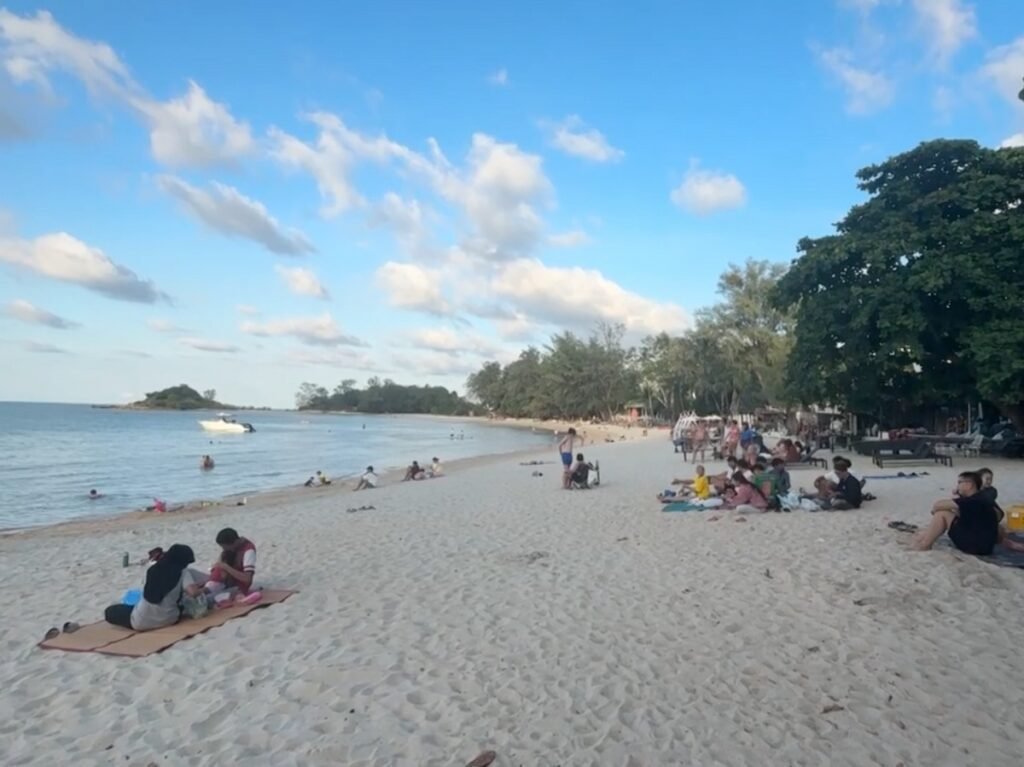
Choeng Mon sits at the northeast tip of Koh Samui, a small peninsula that holds three separate bays and one of the more interesting concentrations of high-end residential architecture on the island. The main beach is a curved kilometre of soft sand and shallow water, generally considered one of the best swimming beaches on Samui, with palm shade that genuinely keeps the heat off in the middle of the day. The neighbouring Tongson and Tongsai bays are smaller, quieter, and harder to find. The Plai Laem hillside that climbs above the area holds villas that include Samujana, the Six Senses, and a handful of architecturally serious private homes whose finished prices run well into double-digit millions of baht.
For a client weighing Choeng Mon, the brief tends to be about quiet luxury rather than rental yield. The area attracts owners who use the property themselves, often for extended periods, and who care about the design more than the spreadsheet. That changes the conversation considerably from somewhere like Bangrak or Lamai.
Important update before going any further
A new environmental protection law for Surat Thani Province came into force on 21 May 2025, applying to Koh Samui, Koh Phangan, Koh Tao, and surrounding islands. It introduces seven new environmental protection zones with significant new restrictions on hillside development.
The points worth knowing for Choeng Mon specifically:
- In the new hillside zones, only one single-family home is permitted per parcel, capped at 6 metres in height with 50% required green space
- Retaining walls and resort-style developments are no longer permitted in the affected hillside zones
- Land subdivision is prohibited in those zones
- On any sloped land at 35% gradient or above, special permission is required to grade or alter the terrain or remove large trees
Most of the existing luxury villas on the Plai Laem hillside were built before this law and operate under the older rules. New projects on elevated land in the area now need careful zoning verification against the May 2025 maps before purchase. A surveyor and a current planning map are the only reliable way to know which zone a specific plot falls into.
The land, in three sections
Choeng Mon’s landscape splits cleanly into three working zones, each with its own design conversation.
The main Choeng Mon bay is a flat coastal strip behind a curved beach, running roughly a kilometre from headland to headland. The village runs parallel to the beach, holding the small resorts, restaurants, the Wednesday walking street market, and the everyday amenities. Plots near the beach are tight and most are already built on, with new development happening as replacement or infill. The two five-star hotels that anchor the bay (Sala Samui at one end and Melati at the other) have shaped what is and is not available at the beachfront.
Tongson and Tongsai bays sit between Choeng Mon and Plai Laem, accessed by single roads that descend from the main route. Tongson is small, secluded, with rocky pools at one end and a sandy stretch at the other. Tongsai is functionally private, accessed only through the long-established Tongsai Bay hotel. Plots in either bay are rare on the open market and tend to be held within families or estates that do not transact often.
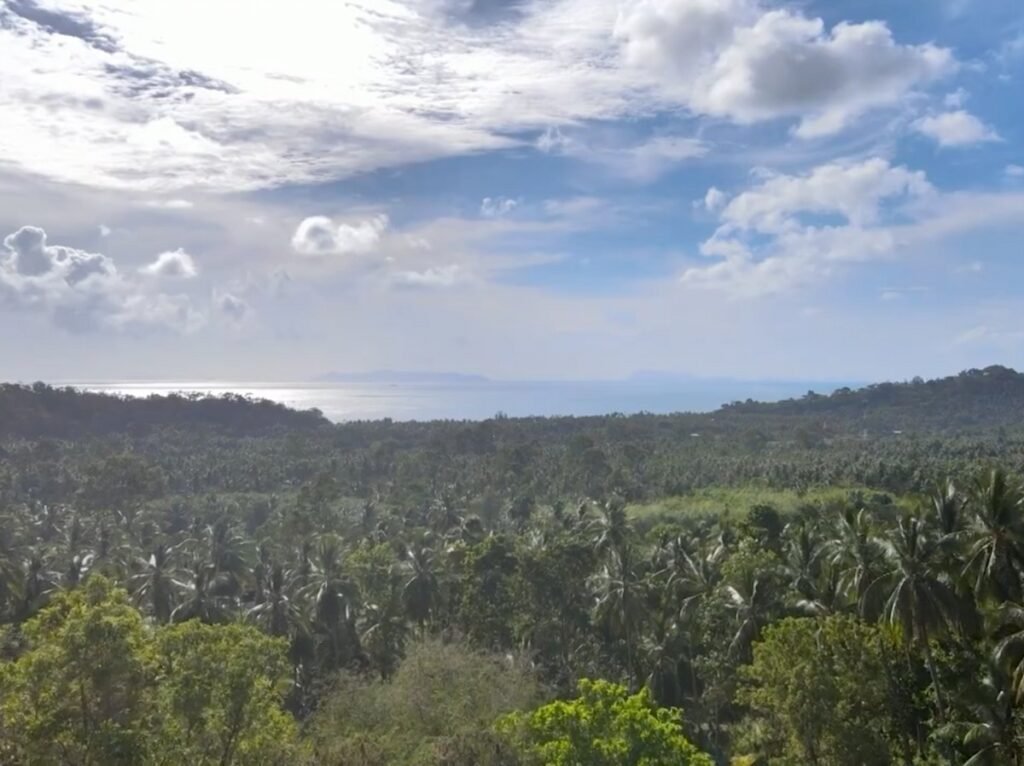
The Plai Laem peninsula climbs from the coast up to a series of headlands and ridgelines that command some of the most spectacular views available on the island. This is where most of the area’s serious villa product sits. Sea views back across Bophut bay, sunset views over the north coast, the offshore Koh Som island visible from many plots. The land here is at altitude, often on slope, and now sits squarely inside the May 2025 environmental framework. It is also where Choeng Mon land prices climb hardest.
What good design has to handle here
Choeng Mon’s east-facing main bay catches the morning sun and is largely sheltered from the afternoon glare by the Plai Laem ridge to the west. This is unusual on the island and worth designing around. Living spaces oriented east towards the beach get good morning light without the late-afternoon overheating that plagues west-coast plots. Bedrooms east, terraces and pools east, kitchens and service zones tucked behind. The west elevation needs less heroic shading than it would in Lipa Noi or Taling Ngam.
The Plai Laem hillside is a different problem. Plots here typically face north or northwest, with the view back across the bay and the sunset to one side. Designs need to be more deliberate about orientation, often with the building rotated to capture both the view axis and the light, with the social spaces facing the view and the private spaces slightly turned. The afternoon sun on west-facing rooms still needs proper shading, but the view direction usually wants to be honoured first, and the shading designed into the secondary elevations.
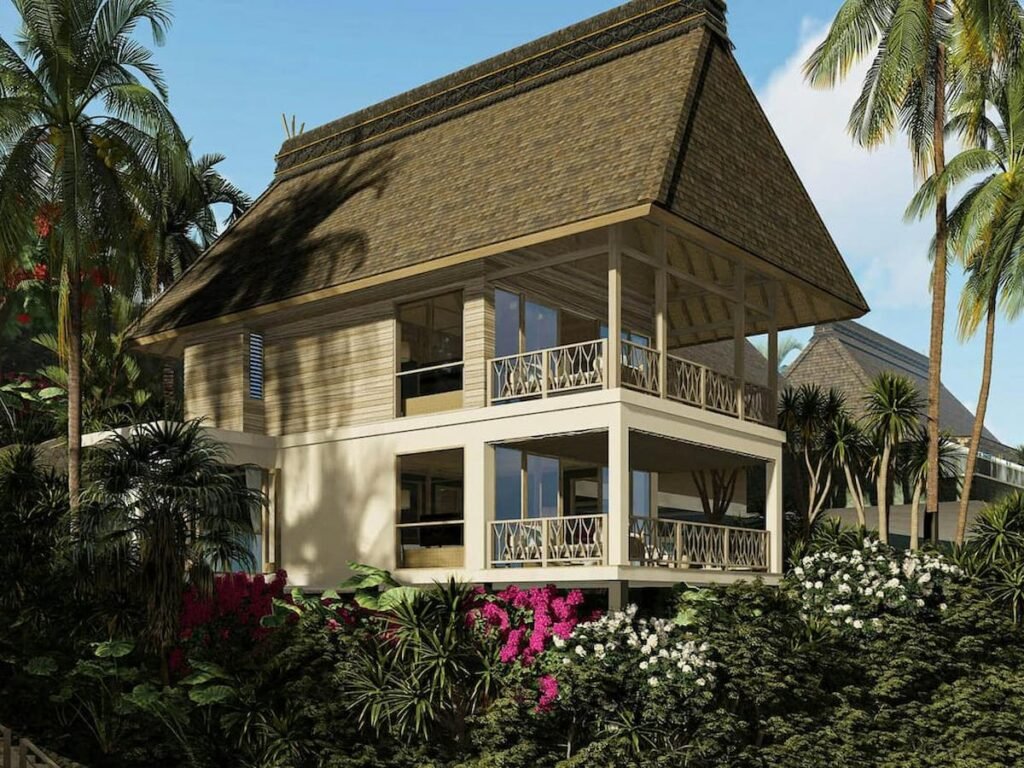
The biggest single design factor in Plai Laem is the slope. Most of the desirable elevated plots sit on gradients between 20 and 40 degrees, and the buildable envelope shrinks fast as you climb. Above 80 metres altitude the standard 6-metre height limit applies, which forces a stepped or tiered design rather than a tall block. The best Choeng Mon hillside villas (Samujana 30 and the higher Sangsuri properties are good examples) take this constraint and use it: each level becomes a discrete pavilion linked by external walkways, with the overall mass broken down into pieces that sit comfortably on the slope.
Foundation work on the hillside is generally on weathered granite with bedrock close to the surface. This is good for bearing capacity but limits cut-and-fill operations to 2 metres maximum. Stepped concrete foundations cast against the natural slope are standard, and retaining walls (where still permitted under the new rules) become part of the architectural vocabulary rather than something hidden.
The northeast monsoon hits this side of the island from November through January and is the wet season. Drainage on the hillside is non-negotiable: surface runoff during peak rains can scour an unprotected slope, and any design here needs to engineer where the water goes from the moment it lands. Plots on the flat coastal strip have a more forgiving water table than Bangrak’s flatter ground, but proper stormwater management still matters.
Privacy as a design problem
Choeng Mon is the part of the island where neighbours notice each other. The plots are smaller than Taling Ngam, the buyers are wealthier than Lamai, and the desire to feel completely private on a 600 square metre lot is real and contradictory.
Good Choeng Mon design solves this with the building, not the boundary. Walls and fences set up a fortress aesthetic that does not suit the climate or the architectural language buyers in this area expect. The better solution is to use the building’s own walls and roof forms to screen the views into the property from neighbouring plots. A villa designed with its long elevation parallel to the most exposed boundary, with fenestration concentrated on the view side and solid mass on the neighbour-facing side, can feel completely private without ever putting up a wall.
Pool siting follows similar logic. A pool sited on the boundary side of a plot is overlooked. A pool sited within the building footprint, embraced by the form, is private even on a small plot. This is the design move that distinguishes a thoughtfully placed Choeng Mon villa from a poorly placed one.
Lifestyle and infrastructure
Choeng Mon has the everyday infrastructure of a settled residential area. Mains water, three-phase electricity, fibre internet, proper sewerage. The road network is decent, though the roads in the main village are narrow and back up at peak times. The Ring Road connects efficiently to the airport (10 minutes), Bangrak and Fisherman’s Village (10 minutes), and Chaweng (10 to 15 minutes).
The amenities are what an upmarket residential area needs rather than what a tourist hub provides. A handful of well-regarded restaurants, several spas concentrated in the resorts, the walking street market on Wednesdays, banks, pharmacies, convenience stores. There is no central fresh market, which is one of the more practical inconveniences of living here. For full grocery shopping, most residents drive to the Big C or Lotus’s at Bangrak or further into Chaweng.
The community is more international than most of the island. Expat residents, retirees, second-home owners who fly in for several months a year, the small staff of the Six Senses and Sala. The vibe is upmarket but not flashy. Choeng Mon does not have nightlife, and the few bars and live-music venues close earlier than their equivalents in Chaweng or Fisherman’s Village. For evening options, most residents drive ten minutes to one of the surrounding areas.
For a family with school-age children, the proximity to the international schools cluster on the north coast is the practical advantage. For a long-term owner, the area’s quietness, beach quality, and architectural standard are the draw. For a short-stay rental investor, Choeng Mon yields are decent but the entry price is high enough that the maths often work less favourably than in Bangrak or Lamai.
A practical sequence for a Choeng Mon plot
The standard sequence applies. Confirm the Chanote, check boundaries against the ground, verify zoning under both the older planning maps and the May 2025 environmental zones, check altitude and slope on any hillside plot, confirm distance from the high-tide line for anything coastal, then commission soil and drainage assessments before feasibility design begins.
The Choeng Mon-specific things to watch for are the May 2025 environmental rules on the Plai Laem hillside (which can materially change what is permitted on a plot you are considering), boundary disputes that occasionally surface on the smaller flat-strip plots in the village area, and access rights on the lanes leading down to Tongson and Tongsai bays where some routes are technically private and shared between landowners.
Final note
Choeng Mon was one of the first parts of Samui to attract serious residential architecture, and it remains the place where the most considered private homes on the island tend to be built. The combination of a swimmable family beach, the Plai Laem hillside, the proximity to airport and amenity, and a settled international community makes it one of the more livable corners of Samui for the right brief.
It is the part of the island this practice has the deepest personal connection to. Childhood visits to the main beach, a father’s love of the bay, the small pleasure of watching it shift over the years from quiet local secret to upmarket residential cluster while still keeping much of what made it good in the first place. For the right client, with the right brief, it remains one of the most rewarding places on Samui to design and build a home.
Considering land in Choeng Mon, Bangrak, Lamai, Taling Ngam, Lipa Noi, Nathon, Bangpor, or Maenam? Get in touch for a preliminary land viability assessment. Don’t forget to check out our Youtube channel or our knowledge hub here.
See also:
- Nathon: building in Koh Samui’s old capital
- Lipa Noi: building on Samui’s quiet southwest
- Taling Ngam: building on the Virgin Coast
- Lamai: building on the east coast’s working alternative
- Bangrak: building under the flight path
Note on regulations: zoning, height, altitude, slope, and environmental protection rules are subject to change and to local enforcement variations. The 21 May 2025 Surat Thani environmental law in particular has introduced new restrictions that may not yet be reflected in older online guides. Always verify current rules with the Land Office and a licensed Samui architect or legal advisor before relying on this guide for any acquisition or build decision.