An architect’s guide to land, sound, and what the north coast asks of a design.
Bangrak translates loosely as “place of love,” which is more affectionate than the area itself sometimes feels. This is the busiest pocket of Koh Samui’s north coast, anchored by the 12-metre Big Buddha statue at the western end of the bay and the international airport less than ten minutes away. The beach is genuinely good in parts, calm and swimmable year round, with a protected bay that rarely sees the strong currents found elsewhere on the island. It is also the place where a low-flying jet will pass directly over your roof three or four times an hour during peak season. Both of those things are part of the brief.
For a client weighing Bangrak, the question is not really whether the area is appealing. It clearly is, and the rental and resale numbers prove it. The question is whether the specific friction points (aircraft noise, congestion near the airport approach, patches of beach with coral and rocks rather than clear sand) match the way the client actually intends to use the property.
Important update before anything else
A new environmental protection law for Surat Thani Province came into force on 21 May 2025, applying to Koh Samui, Koh Phangan, Koh Tao, and surrounding islands. This is on top of the existing Building Control Act and Town Planning Act rules, not a replacement for them, and it tightens hillside development materially.
The headline changes worth knowing about:
-
- Seven new environmental protection zones are now defined across the islands
-
- In the new hillside zones, only one single-family home is permitted per parcel, with a 6-metre maximum height and 50% required green space
-
- Retaining walls and resort-style developments are no longer permitted in the hillside zones
-
- Land subdivision is prohibited in the affected hillside areas
-
- On any sloped land at 35% gradient or above, special permission is required to grade or alter the terrain or to remove large trees
-
- Developments with 10 or more rooms now require grease traps, formal wastewater treatment, and proper drainage as a baseline
For Bangrak specifically, most of the developable land sits on the flat coastal plain and below the new hillside thresholds, so the headline impact is limited. But any plot considered on the Bangrak Hills above the bay should now be checked against the May 2025 zones before purchase, not just against the older altitude and slope rules. A surveyor and a current planning map are the only reliable way to know which zone a specific plot falls into.
The land, in three parts
The Bangrak landscape splits cleanly into three working zones.
The flat coastal strip behind the beach is the busiest. This is where Replay (the largest residential complex in the area), most of the boutique resorts, the Big Buddha pier with its boats to Koh Phangan and Koh Tao, and the cluster of restaurants like Sabienglay and Foxtrot all sit. Plots are tight, the road layout is narrow and works against any large vehicle delivery, and most fresh development here is replacement or infill rather than new ground.
The middle band, set back from the beach but below the Bangrak Hills, is where most of the recent villa product is going. Pool villas in the 6 to 12 million baht range, three-bedroom homes designed with rental management in mind, gated communities with shared pools and security. This is the practical sweet spot for a Bangrak project: the zoning is generally permissive, plot sizes are workable, and the airport, beach, and Fisherman’s Village are all within ten minutes.
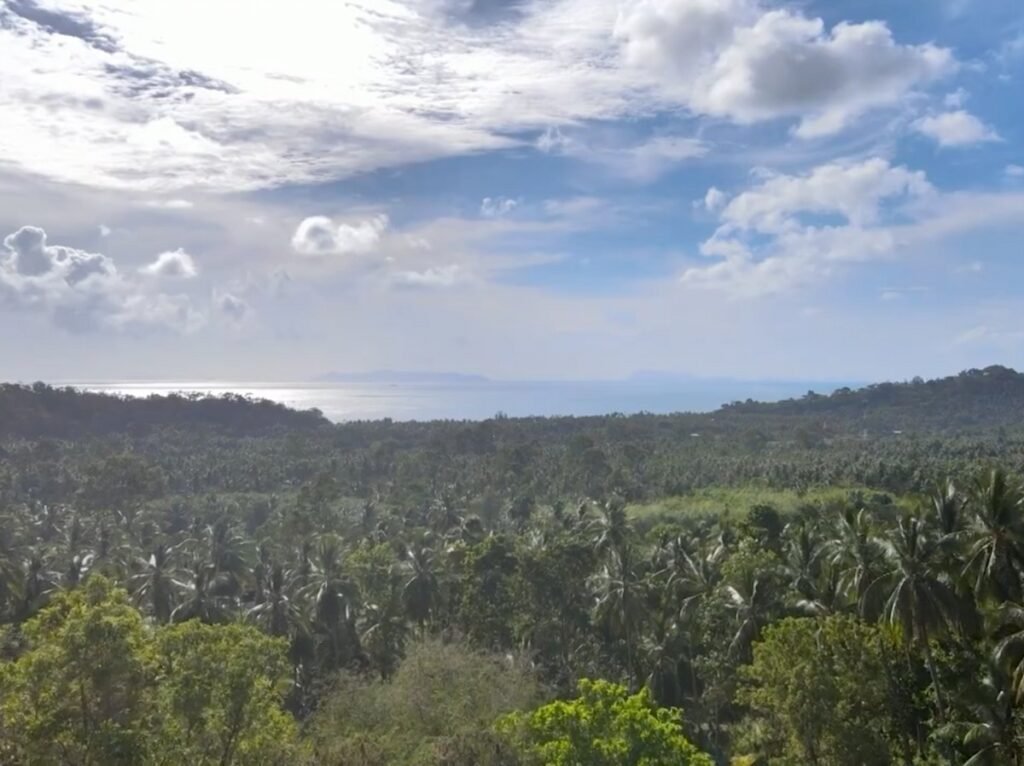
The Bangrak Hills behind and to the east are where the higher-end residences and hillside resort developments cluster. Sea views back across the bay are excellent, sunset views toward Koh Phangan are some of the best on this stretch of coast, and the air is noticeably cleaner of road dust. This is also where the new May 2025 environmental rules bite hardest, so any project on the hill needs careful zoning verification.
What good Bangrak design has to handle
The single design problem that is genuinely particular to Bangrak is aircraft noise. Samui Airport is small by international standards but it is busy, and the approach path runs almost directly over the eastern half of the bay. A villa in the wrong location with the wrong specification will sound like an air traffic control tower for parts of the day.
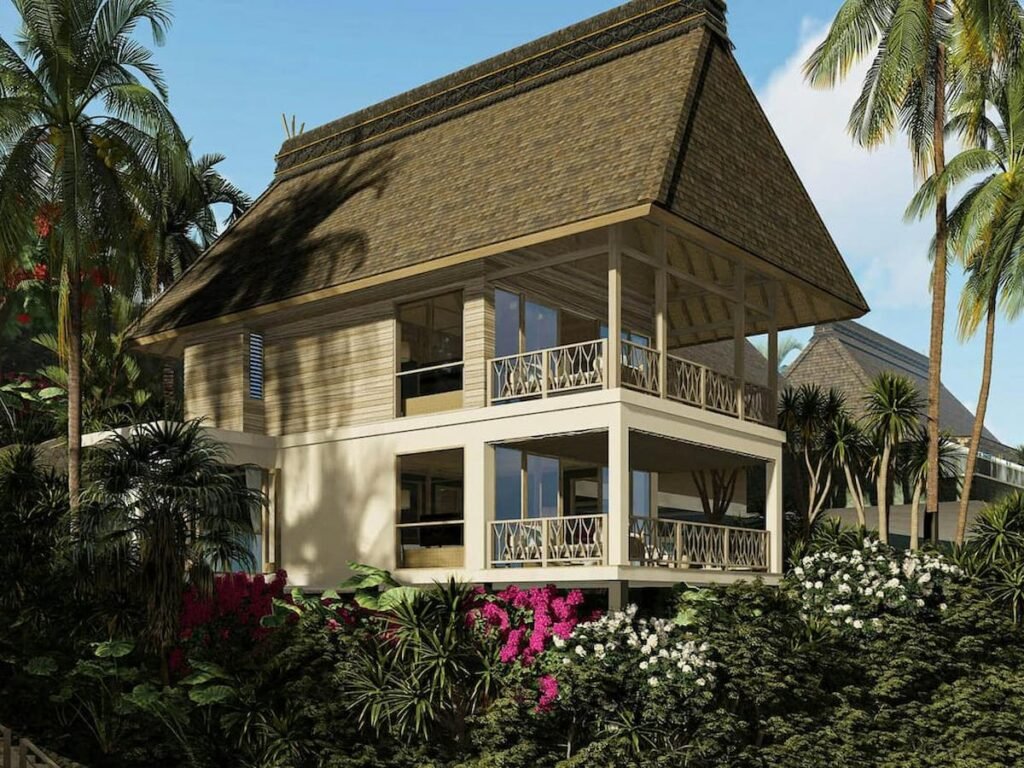
The architectural response is acoustic, not architectural in the visual sense. Double glazing is non-negotiable on any opening that faces the flight path. Roof construction needs proper insulation, both thermal and acoustic, with mass-loaded membranes rather than just standard fibreglass batts. Wall construction wants to be denser than the cheapest local block work, ideally with a cavity or an internal acoustic layer. Outdoor living spaces benefit from being placed on the leeward side of the building, with the building mass itself shielding them from the approach path.
The good news is that the techniques are well understood, the materials are available locally, and the cost premium for proper acoustic specification is modest at design stage but very expensive to retrofit. A villa designed acoustically from day one performs well. A villa designed without that input and then patched after handover rarely catches up.
The other design considerations are the standard north coast set. The morning sun rises over the Gulf and east-facing rooms catch direct light from sunrise until late morning. The northeast monsoon hits the coast from November through January and is the wet season for this side of the island. Drainage on the flat coastal strip needs to handle real storm volumes, particularly on plots below the Bangrak Hills where runoff from the slope above will arrive on your land before it reaches the sea.
Geology is granite-based and reasonably forgiving for foundation work, though the flat coastal strip has alluvial overburden in places and a moderate water table. Two-storey work near the beach is generally fine on properly engineered foundations.
Zoning, briefly
Bangrak carries the standard mix of Samui zoning categories. Yellow zones (low-density residential) cover most of the buildable inland and the lower hillside, with the standard 40% open space requirement and 12-metre height cap. Orange zones (medium-density residential) appear closer to the centre and allow tighter coverage, which is part of why apartment and condo product makes economic sense in Bangrak. Light green and blue zones apply to the coastal and aquatic strips with the standard distance-from-beach rules.
The altitude rules apply as elsewhere: standard zoning below 80 metres, single residences only at 6-metre height between 80 and 140 metres with a 400 square metre minimum plot and 50% green space, and a 90 square metre footprint cap above 140 metres. Slope rules add restrictions above 35 degrees and prohibit construction above 50 degrees. The May 2025 environmental layer sits on top of all this and needs separate verification.
Lifestyle and infrastructure
Bangrak has the best infrastructure of any area on the island outside the airport itself. Mains water, three-phase electricity, fibre internet, proper sewerage. Roads are good in places but congested near the airport approach during peak hours. The Ring Road runs through the area and connects efficiently to Chaweng (10 to 15 minutes), Bophut and Fisherman’s Village (5 minutes), and the international schools cluster on the north coast.
The amenities are good for a residential area. Two markets, a Big C and a Tesco within easy reach, plenty of restaurants from local Thai through to international, gyms, yoga studios, several spa and wellness venues. Big Buddha temple and pier are part of daily life rather than a tourist sideshow. The community is genuinely mixed: long-stay expats, retirees, digital nomads, the airport-adjacent business crowd, and a settled Thai population. The vibe is more international than Lamai and considerably calmer than Chaweng.
For a family with school-age children, the proximity to the international schools is the practical advantage. For an investor, the airport proximity drives short-stay rental yields that the west coast cannot match. For a long-term resident, the trade-off is the noise and traffic for everything else the area offers.
Due diligence in Bangrak
The standard sequence applies. Confirm the Chanote, check the boundaries against the ground, verify zoning under both the older planning maps and the May 2025 environmental zones, check altitude and slope on any hillside plot, confirm distance from the high-tide line for anything coastal, then commission soil and drainage assessments before feasibility design begins.
The Bangrak-specific things to watch for are the flight path (which is publicly mapped and any reputable lawyer or architect can overlay onto your prospective plot), congestion access during airport peak hours, and the new 2025 environmental zones for any hillside purchase.
Final note
Bangrak is for clients who value access. Quick to the airport, quick to amenities, swimmable beach, working community, decent restaurants, ferries to the neighbouring islands. It is not for clients whose first priority is silence or seclusion. The aircraft are a real and recurring presence and pretending otherwise sets up a disappointed buyer.
Designed properly, with the noise treated as a discipline rather than ignored, a Bangrak villa or apartment is one of the more practically livable buildings on the island. It is also one of the more rentable. For the right brief, the area earns its place on a serious shortlist.
Considering land in Bangrak, Lamai, Taling Ngam, Lipa Noi, Nathon, Bangpor, or Maenam? Get in touch for a preliminary land viability assessment. Also, check out our Youtube channel for videos about Bangrak and if you need a resource for building, go to our information site here.
See also:
Note on regulations: zoning, height, altitude, slope, and environmental protection rules are subject to change and to local enforcement variations. The 21 May 2025 Surat Thani environmental law in particular has introduced new restrictions that may not yet be reflected in older online guides. Always verify current rules with the Land Office and a licensed Samui architect or legal advisor before relying on this guide for any acquisition or build decision.