An architect’s guide to the Soho of Samui, where land prices and design problems are both at their highest.
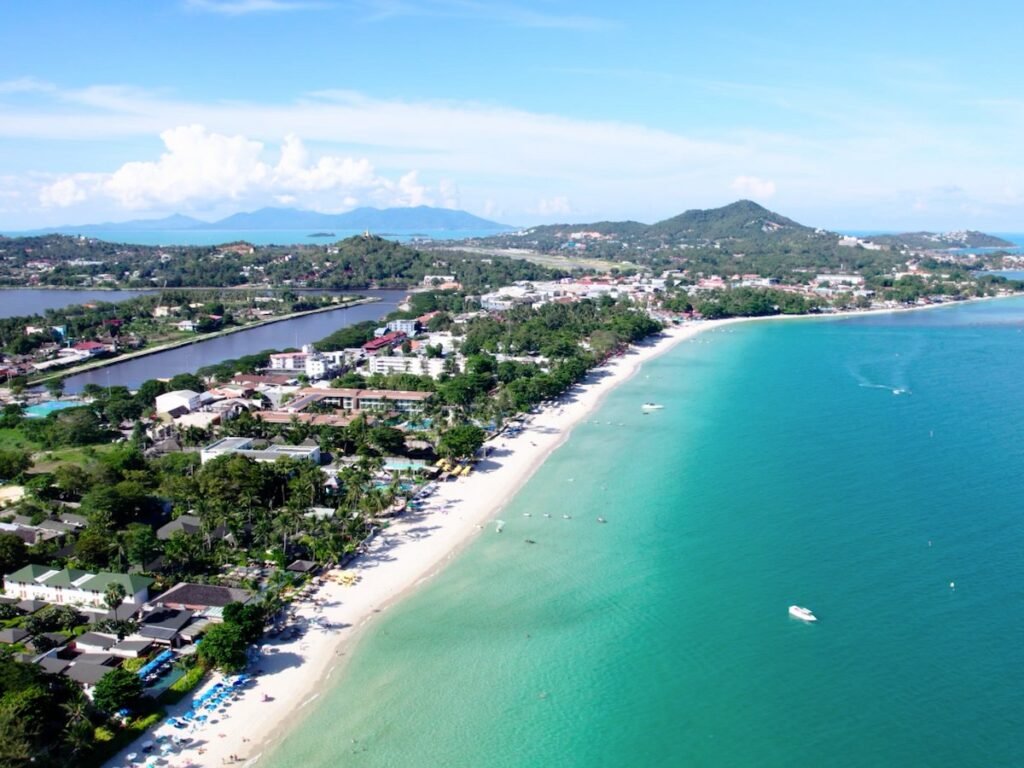
Chaweng is Samui’s commercial centre. A seven-kilometre beach, the island’s only proper shopping mall, two of its three major hospitals, the bulk of its restaurants and bars, and a working night economy that runs from sunset until late. It is the Soho of Samui in the most literal sense: the place people come to spend money, dance, eat, drink, and stay in a hotel for a few nights before retreating somewhere quieter. It is also the place where land prices are at their peak (beachfront plots transact at 150,000 baht and above per square wah), where commercial zoning is at its most permissive, and where the architectural brief most often involves mixed use rather than pure residential.
Chaweng is not where you build a private retreat. It is where you build a business with a flat above it, or a serviced apartment block, or a small boutique hotel, or a condo unit that pays its way as a short-stay rental. The conversation is commercial first and residential second. For the right brief, that is exactly the appeal.
Important update before going further
A new environmental protection law for Surat Thani Province came into force on 21 May 2025, applying to Koh Samui, Koh Phangan, Koh Tao, and surrounding islands. It introduces seven new environmental protection zones with significant new restrictions on hillside development.
The points worth knowing for Chaweng:
- In the new hillside zones, only one single-family home is permitted per parcel, with a 6-metre maximum height and 50% required green space
- Retaining walls and resort-style developments are no longer permitted in the hillside zones
- On any sloped land at 35% gradient or above, special permission is required to grade or alter the terrain or remove large trees
- Developments with 10 or more rooms now require grease traps, formal wastewater treatment, and proper drainage as a baseline
The flat heart of Chaweng (where most of the commercial development sits) is largely unaffected by the new hillside rules. The Chaweng Noi headland and the higher slopes behind the main beach are now firmly inside the new framework, and any project on elevated land in those areas needs careful zoning verification before purchase.
The land, in three working zones
Chaweng splits into three distinct working zones for development purposes.
The flat commercial core runs from the beach inland for roughly half a kilometre on either side of Chaweng Beach Road. This is where the bars, clubs, restaurants, retail, and serviced apartments concentrate. Plots are tight, the road grid is congested, and most fresh development happens as replacement or vertical infill rather than new ground. The zoning here permits the highest density on the island: orange and red zones with up to 80% buildable coverage and 12-metre height limits.
The middle ring, set back from the beach but still inside the bustle, is where the bulk of the residential condo product is going. Mid-rise blocks of studios, one-bed, and two-bed units, typically with shared pools and gyms, marketed primarily at investors. This is where projects like Wing Samui (the largest freehold condo complex on the island, between Bophut and Chaweng) and a steady stream of similar developments are being built.
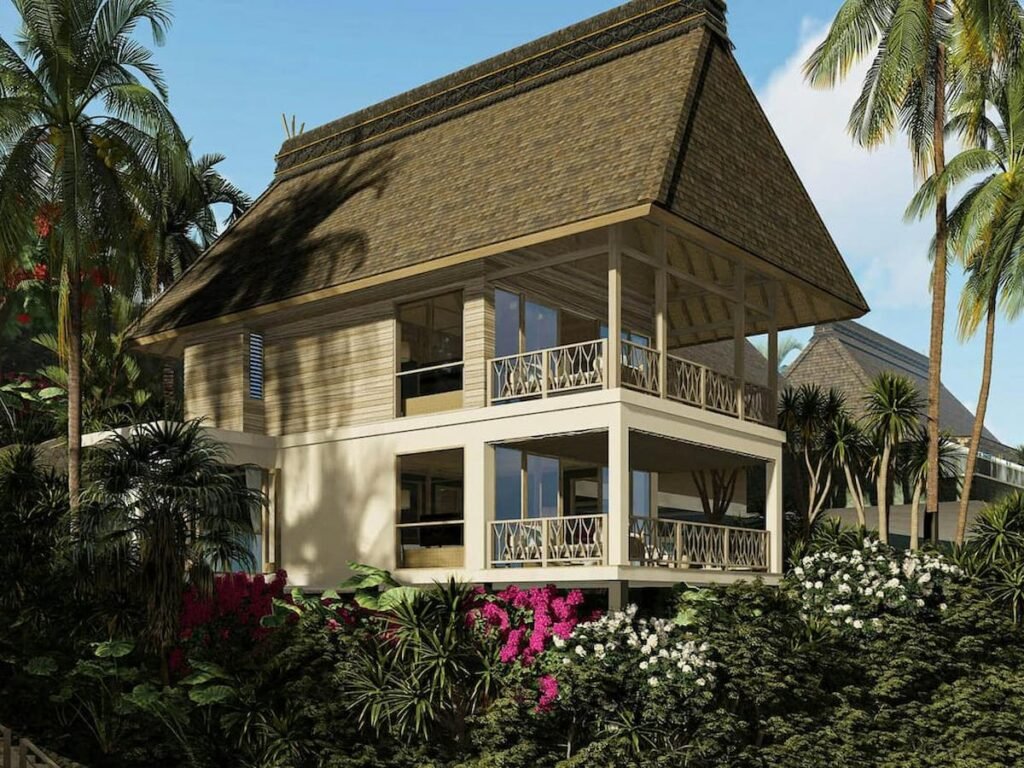
Chaweng Noi is the hillside sub-area to the south, separated from main Chaweng by a small headland. The beach here is smaller, calmer, and considerably less developed. Land prices are still high, but the brief shifts towards hillside villas with sea views rather than urban-density commercial. Several of the more architecturally serious recent developments (XV Samui, The Wave 2, the Anantara and Lawana resort cluster) sit in this band.
What good Chaweng design has to handle
Chaweng’s central design problem is sound. Verified noise readings in central Chaweng during high season hit 65 to 75 decibels at night from beach clubs and entertainment venues, with properties within 200 metres of Beach Road taking the worst of it. This is not an abstract concern. A villa or condo with poor acoustic specification within that radius is a unit that will struggle to attract long-stay renters and will generate guest complaints in the short-stay market.
The architectural response is consistent with what proper urban housing requires anywhere. Double or triple glazing on any opening that faces a noise source. Mass-loaded acoustic membranes built into wall and roof construction. Floor-to-floor sound separation in multi-unit buildings, ideally with concrete slabs rather than the cheaper composite alternatives. Bedroom placement away from the noisiest elevations, with service spaces and bathrooms used as buffer zones between the bedroom and the street. Solid-core internal doors. Properly detailed window seals. None of this is exotic. It is just the standard of work the location actually requires.
The east-facing main beach catches the morning sun, with afternoon shade arriving from the inland buildings and the small Chaweng Noi headland. This is generally easier to design for than the west-coast aspects covered in earlier guides in this series. Bedrooms east, evening living spaces west, with the building mass itself shielding the worst of the late-afternoon glare.
The northeast monsoon hits the coast from November through January, which is the wet season here. Drainage on the flat commercial strip is critical: the water table is shallow, the street network is flat, and Chaweng is one of the more flood-prone parts of the island during peak rainfall. Ground-floor retail and service spaces in beachfront builds typically sit on raised platforms, with proper engineered stormwater management taking surface water away from the property before it reaches the building.
The geology of the flat Chaweng strip is alluvial soils with limited shallow bearing capacity. Pile foundations are standard for any structure of two storeys or more. The Chaweng Noi hillside transitions to weathered granite with better load-bearing characteristics, with the standard cut-and-fill 2-metre maximum applying on slopes above 35 degrees.
The commercial design conversation
Chaweng is the only part of the island where mixed-use is genuinely worth the design effort. Ground-floor retail or restaurant with apartments above. Boutique hotel with rooftop bar. Serviced apartment block with a co-working ground floor. The orange-zone permission for 80% built coverage makes these formats viable in a way they are not elsewhere.
The design discipline here is to give each use what it needs without compromising the others. Retail wants frontage, visibility, and easy ground-floor access. Apartments want privacy, separate entrances, and acoustic separation from anything below. Restaurants and bars want extraction routes for kitchen smoke and noise control on outdoor seating. A building that tries to do all of this badly ends up with apartments that are unrentable above a restaurant that is unprofitable, and the whole thing fails.
Buildings that solve this well typically have a clear vertical zoning: commercial on the ground and first floors with their own dedicated services, residential on the upper floors with separate access and lifts, and a clear acoustic break between the two. Outdoor terraces and rooftop spaces become a useful third layer. Several of the better recent Chaweng projects have used this structure, and it is what most architects experienced in the area would recommend over a purely residential design at this density.
Lifestyle and infrastructure
Chaweng has the best urban infrastructure on the island. Mains water, three-phase electricity, fibre internet, proper sewerage, three large supermarkets (Big C, Tesco’s, and Makro all within ten minutes), Bangkok Hospital, Central Festival shopping centre, the entirety of the island’s chain restaurants from McDonald’s to Starbucks, and a public transport network of songthaews that actually runs after dark.
The road network is good but congested. Beach Road backs up at peak times, and the inland Ring Road (Route 4169) running parallel to it is the practical alternative for through-traffic. The airport is around 15 minutes by road, which is the closest of any commercial area on the island after Bangrak.
The community is genuinely transient. Permanent expat residents are a minority compared to long-stay tourists, digital nomads, the seasonal hospitality workforce, and the rotating cast of short-stay holidaymakers. The settled Thai population tends to live slightly inland, away from the beach road. For a long-term resident, this is the trade-off: amenity is unmatched, but the sense of community is thinner than in Bophut, Choeng Mon, or Lamai.
For a family with school-age children, Chaweng is workable but not ideal. The international schools cluster is on the north coast, requiring a daily commute. For an investor, the commercial yields are the strongest on the island. For a digital nomad on a six-month lease, the area is unbeatable.
Practical due diligence
The standard sequence applies. Confirm the Chanote, check boundaries, verify zoning under both the older planning maps and the May 2025 environmental zones, check altitude and slope on any Chaweng Noi or hillside plot, confirm distance from the high-tide line for anything coastal, then commission soil and drainage assessments before feasibility design begins.
The Chaweng-specific things to watch for are noise exposure (which can be plotted by reference to known club and venue locations), traffic congestion at the access road to your plot, and the post-COVID recovery picture (some Beach Road plots that have been vacant for several years may be cheaper than they look but carry their own legacy issues, including planning permissions that have lapsed and need renewal).
Final note
Chaweng is the place to come if your project has commercial ambition. Mixed-use buildings, condo units that earn from short-stay rental, boutique hotels, serviced apartments, ground-floor retail with residential above. The land is expensive, the design challenges are real, and the noise has to be taken seriously, but the yields and capital appreciation justify the brief for the right client.
It is not the place to come for a quiet residential life. The beach is excellent and the amenities are unbeatable, but the soundtrack is loud, the streets are busy, and the rhythm is commercial. For a working investment or a business-anchored residence, that is exactly the point.
Considering land in Chaweng, Choeng Mon, Bangrak, Lamai, Taling Ngam, Lipa Noi, Nathon, Bangpor, or Maenam? Get in touch for a preliminary land viability assessment.
See also:
- Choeng Mon: building on Samui’s quieter luxury corner
- Bangrak: building under the flight path
- Lamai: building on the east coast’s working alternative
- Nathon: building in Koh Samui’s old capital
- Lipa Noi: building on Samui’s quiet southwest
- Taling Ngam: building on the Virgin Coast
Note on regulations: zoning, height, altitude, slope, and environmental protection rules are subject to change and to local enforcement variations. The 21 May 2025 Surat Thani environmental law in particular has introduced new restrictions that may not yet be reflected in older online guides. Always verify current rules with the Land Office and a licensed Samui architect or legal advisor before relying on this guide for any acquisition or build decision.